


If there’s one thing that no one responsible for a manufacturing site, processing plant, data centre, or industrial facility wants to have to deal with, it is unexpected downtime.
The availability of specialised industrial cooling products from RS, encompassing solutions like axial and centrifugal fans, heat sinks, cooling units, and air conditioning systems, offers potential remedies for downtime caused by overheating.
Let’s take a closer look at how appropriate thermal management and cooling arrangements can dramatically lower your site’s downtime risks, extend asset life, and keep operations running smoothly.
Why Overheating Causes Downtime
Modern industrial equipment consists of increasingly sophisticated electronics, sensors, drives, and control systems.
While these technologies have proved indispensable for improving efficiency and automation, they also generate heat during operation.
In the absence of measures to adequately remove excess heat from such equipment, various problems can occur, including:
- The premature failure of electronic components
- Drives and control systems fading in performance
- Heightened maintenance requirements
- Unexpected shutdowns and safety trips
- Shortened equipment longevity
All these potential consequences of overheating underscore the critical role that thermal management plays in equipment reliability.
With overheating being one of the primary causes of malfunction in electronic devices during the 2020s, it could barely be more important for the right temperature control measures to be put in place at industrial premises.
What Benefits Can Effective Cooling Systems Actually Bring?
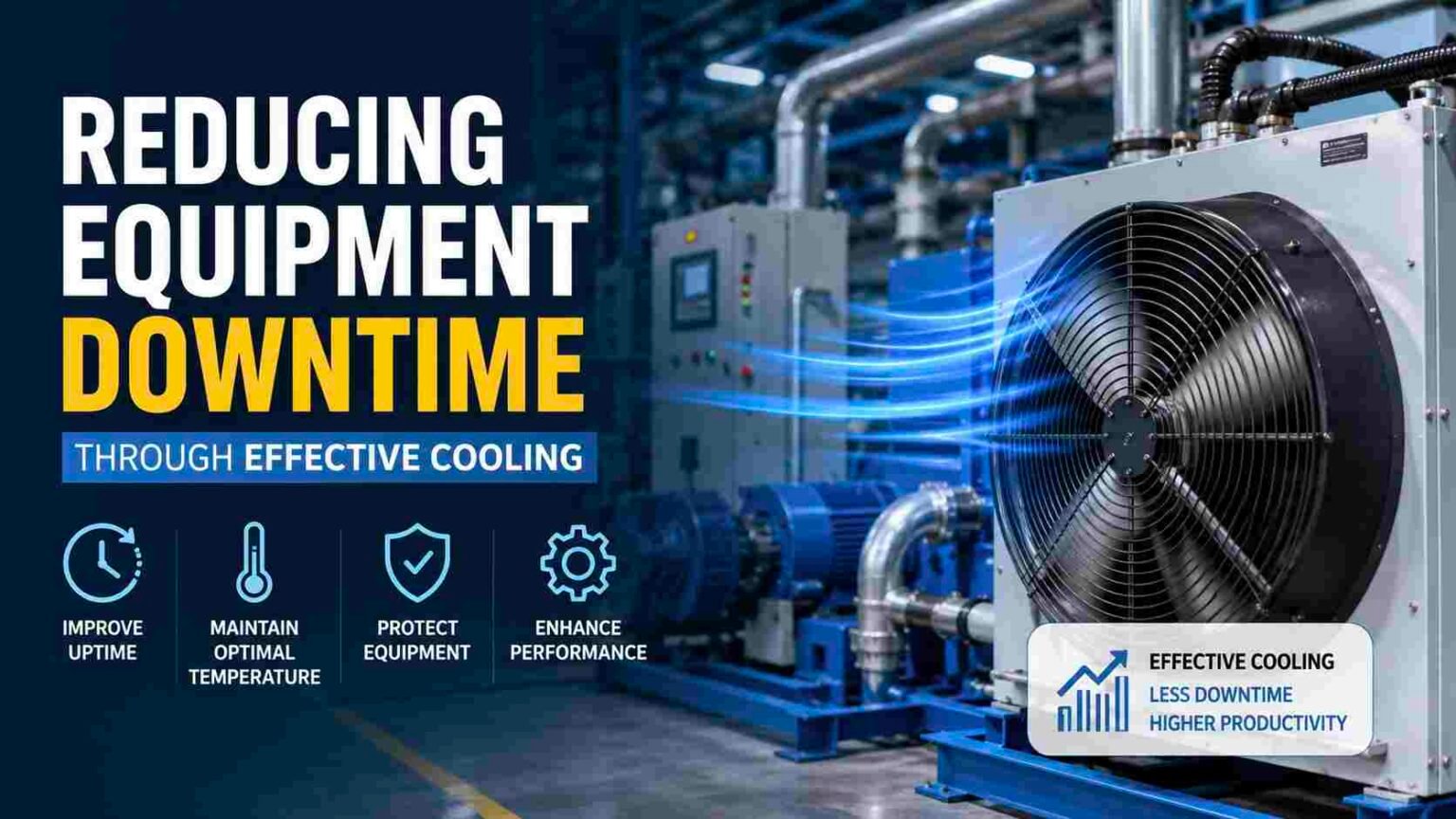
In an industrial context, cooling can be regarded as “effective” when it maintains components within their optimal temperature range. Achieving this goes a long way to improving reliability, energy efficiency, and overall equipment effectiveness (OEE) at a given industrial site.
When appropriate cooling solutions are introduced at a particular location, this can deliver benefits such as:
- Extended equipment lifespan, due to the minimised thermal stress on bearings, semiconductors, and insulation
- Higher uptime, as there likely won’t be as many thermal-related breakdowns
- Energy savings, given that efficient fans and systems typically use less power
- Compliance and safety, as adequate cooling arrangements will allow for better control of ambient conditions for workers and industrial processes.
Take These 5 Practical Steps to Implement Suitable Cooling Measures
The stages of deciding on and investing in the right cooling solutions for your organisation’s premises can be as straightforward as:
- Assessing your current setup. Thermal imaging or temperature monitoring can enable you to pick out hotspots in your equipment and enclosures.
- Determining the most appropriate cooling products. It will be crucial to match such aspects as fan type, airflow, static pressure, and Ingress Protection (IP) ratings to your needs.
- Combining active and passive cooling. Heat sinks and sound airflow design can be used alongside active fans to deliver the best possible outcomes.
- Integrating with maintenance. When you pair cooling upgrades with predictive maintenance, this can greatly help minimise downtime.
- Considering energy efficiency. Modern electronically commutated (EC) fans can help streamline running costs and deliver better performance.
In today’s competitive industrial landscape, you should be looking to pursue every reasonable measure for reducing downtime, given the crucial benefits this can bring for your wider organisation’s profitability and resilience.
Investing in effective cooling is one of the most straightforward ways to protect the equipment at your site and can often bring a positive return on investment (ROI).